
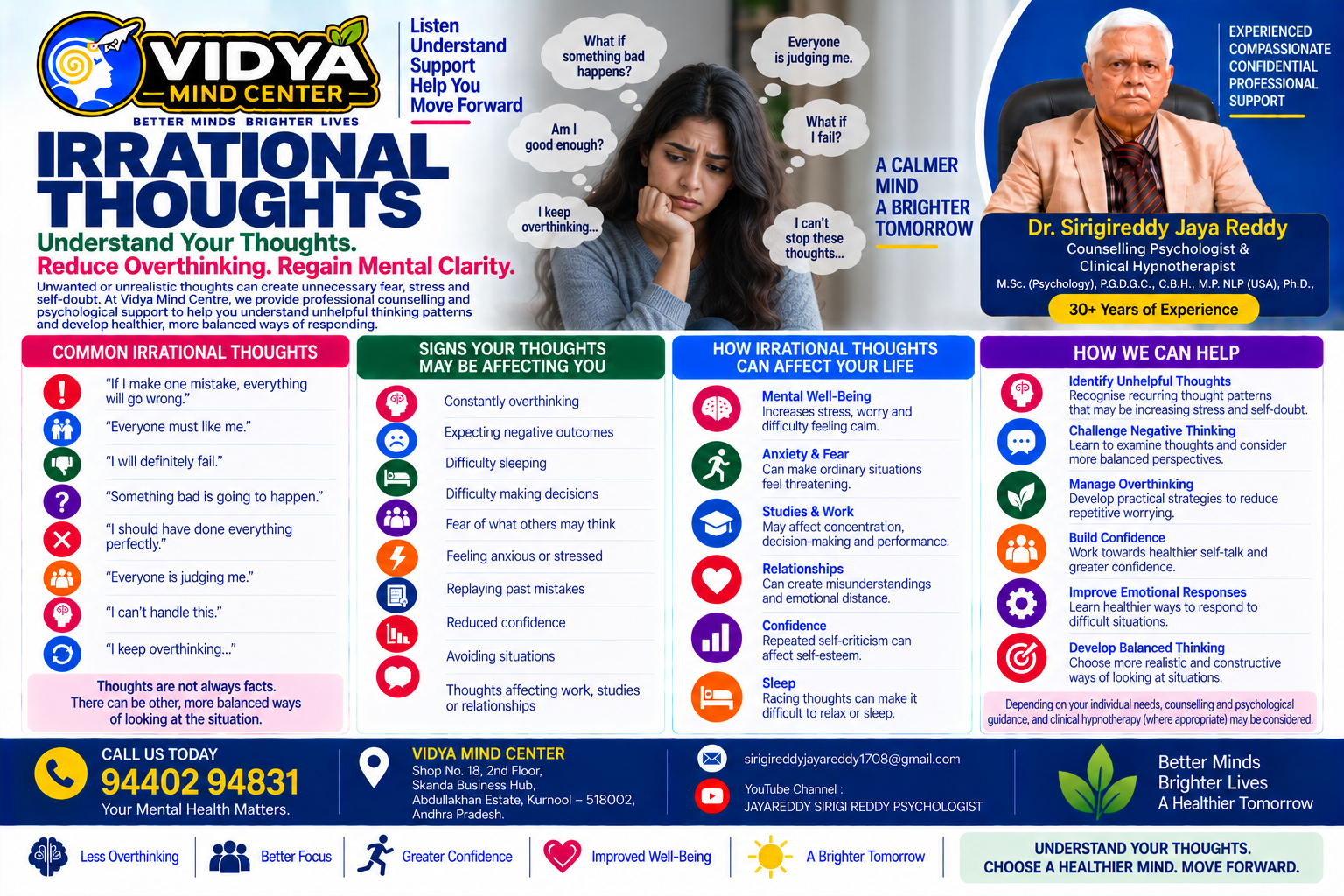
Understand Your Thoughts. Reduce Overthinking. Regain Mental Clarity.
Everyone experiences unwanted, negative, or unrealistic thoughts from time to time. But when irrational thoughts become frequent, intense, or difficult to control, they can create unnecessary fear, stress, self-doubt, and emotional distress.
At Vidya Mind Centre, we provide confidential counselling and psychological guidance to help individuals understand unhelpful thinking patterns, manage overthinking, and develop healthier and more balanced ways of responding to thoughts and situations.
What Are Irrational Thoughts?
Irrational thoughts are thoughts or beliefs that may be unrealistic, exaggerated, overly negative, or not supported by the available evidence. They can feel very convincing even when there may be other, more balanced ways of looking at the situation.
For example:
- “If I make one mistake, everything will go wrong.”
- “Everyone must like me.”
- “I will definitely fail.”
- “Something bad is going to happen.”
- “I should have done everything perfectly.”
- “Everyone is judging me.”
- “One failure means I am a failure.”
Having such thoughts does not make you a bad or weak person. Thoughts are not always facts.
Common Thinking Patterns
Irrational or unhelpful thinking may involve:
💭 Overthinking
Continuously analysing the same situation without reaching a solution.
⚠️ Catastrophic Thinking
Automatically expecting the worst possible outcome.
🎯 All-or-Nothing Thinking
Seeing situations as completely successful or completely unsuccessful, with no middle ground.
👥 Mind Reading
Assuming you know what other people are thinking without clear evidence.
🔄 Negative Self-Talk
Frequently criticising yourself or focusing only on your mistakes.
📋 Excessive “Should” Thinking
Feeling that you or others must always behave in a particular way.
🔮 Predicting the Future
Assuming something negative will happen before there is evidence that it will.
Signs Your Thoughts May Be Affecting You
You may benefit from support if you:
- Constantly overthink situations
- Expect negative outcomes
- Frequently doubt yourself
- Find it difficult to stop worrying
- Replay past conversations or mistakes
- Feel afraid of what others may think
- Have difficulty making decisions
- Experience stress because of your thoughts
- Avoid situations because of fear or negative expectations
- Find that your thoughts are affecting sleep, studies, work, or relationships
How Irrational Thoughts Can Affect Your Life
🧠 Mental Well-Being
Repeated negative thinking can increase emotional stress and make it difficult to feel calm.
😟 Anxiety & Fear
Unrealistic or exaggerated thoughts can make ordinary situations feel threatening.
📚 Studies & Work
Overthinking and self-doubt can interfere with concentration, decision-making, and performance.
❤️ Relationships
Assuming what others think or constantly worrying about rejection can create misunderstandings and emotional distance.
🌱 Confidence
Repeated self-criticism can gradually affect self-esteem and confidence.
😴 Sleep
Racing thoughts and worry can make it difficult to relax and sleep peacefully.
How We Can Help
At Vidya Mind Centre, we help you understand the connection between thoughts, emotions, and behaviours.
🧠 Identify Unhelpful Thoughts
Recognise recurring thought patterns that may be increasing stress, fear, or self-doubt.
💭 Challenge Negative Thinking
Learn to examine thoughts and consider whether they are realistic, balanced, and supported by evidence.
🌿 Manage Overthinking
Develop practical strategies to reduce repetitive worrying and mental exhaustion.
💪 Build Confidence
Work towards healthier self-talk and greater confidence in your abilities and decisions.
❤️ Improve Emotional Responses
Learn healthier ways to respond to difficult situations instead of automatically reacting to negative thoughts.
🎯 Develop Balanced Thinking
Learn to consider different perspectives and respond to situations more calmly and realistically.
Depending on individual needs, counselling and psychological guidance, and clinical hypnotherapy where appropriate, may be considered as part of the support.
You Don’t Have to Believe Every Thought You Have
A thought can feel powerful without necessarily being true. Learning to notice, question, and understand your thoughts can help you respond to life’s challenges more effectively.
The goal is not to eliminate every negative thought. It is to develop the ability to recognise unhelpful thinking and choose a healthier response.
When Should You Seek Support?
Consider professional guidance when persistent or distressing thoughts are affecting your:
- Sleep
- Concentration
- Studies or work
- Relationships
- Confidence
- Emotional well-being
- Daily activities
If thoughts become overwhelming or involve self-harm or suicide, seek immediate professional or emergency support.
Take the First Step Towards a Clearer Mind
Dr. Sirigireddy Jaya Reddy
Counselling Psychologist & Clinical Hypnotherapist
Vidya Mind Centre | 30+ Years of Experience
📞 Call: 94402 94831